
Family-owned · Serving Los Angeles County
We stock your breakroom. The equipment costs you nothing.
Micro markets, vending machines and coffee for workplaces across Los Angeles County — installed, filled and serviced by a local crew. You pay for what your team buys, and nothing else.
- No contract, or month to month. Cancel whenever.
- Coolers, racking and machines installed at our cost.
- Tap, chip, Apple Pay, Google Pay and cash on every machine.
- An LA crew who knows your building, not a 1-800 queue.
No commitment. We reply the same business day.
What a national operator will not give you
The big vending companies sign you for three to five years and route your service calls out of state. Everything below is the opposite of that, and all of it is checkable.
- No contract, or month to month
- Start with no agreement at all. If you would rather have something on paper, a month-to-month is fine. Give us reasonable notice and we pull the equipment out — no exit fee, no argument.
- Equipment at our cost, not yours
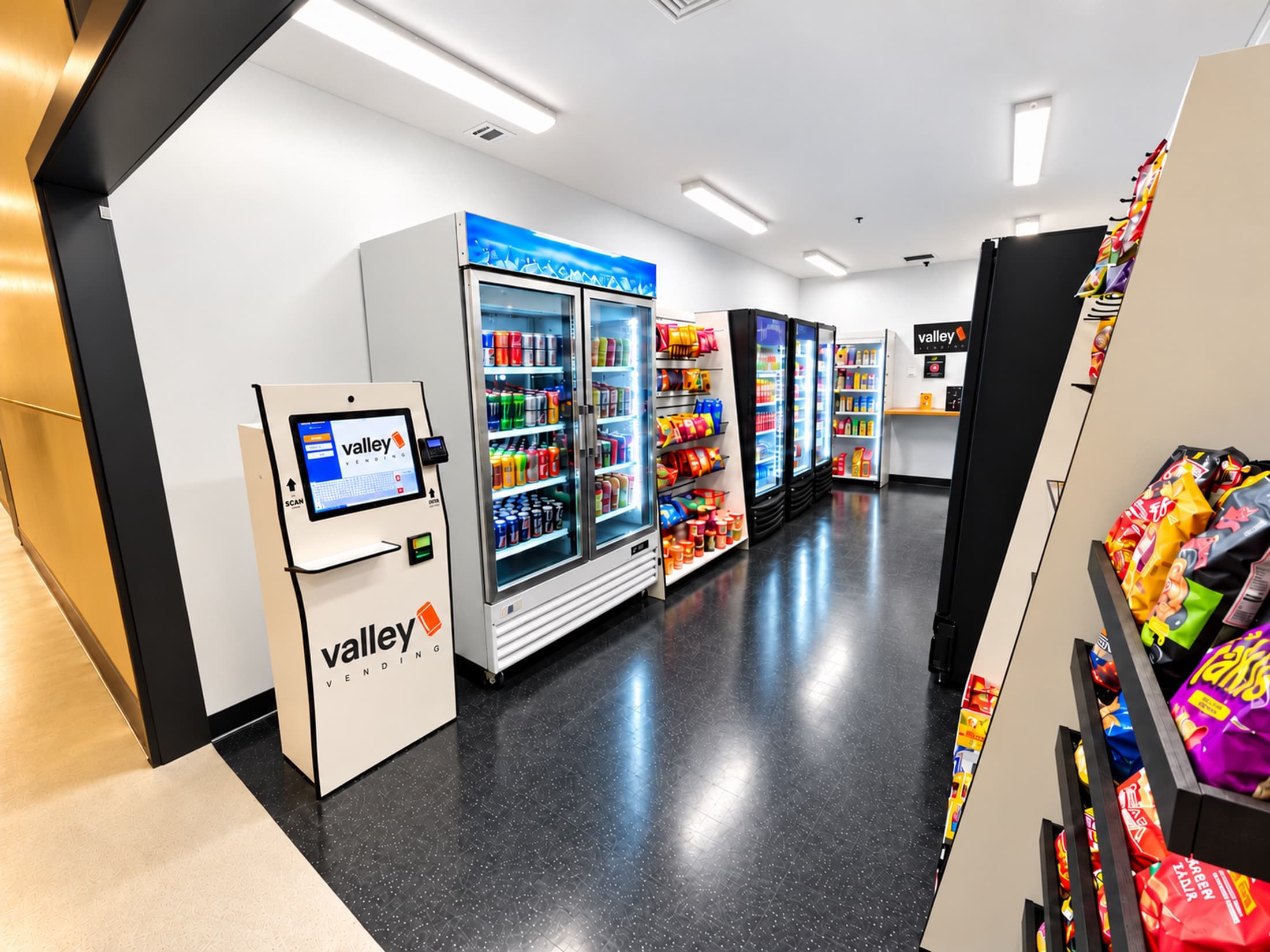
- Coolers, freezers, racking, the self-checkout kiosk and every machine are ours. We install them, we fix them, we replace them when they age out. Your contribution is floor space and power.
- Prices you can check
- We buy direct from the major beverage and snack distributors and from California fresh-food producers. If another local operator quotes a lower shelf price on the same item, show us and we will match it.
- A crew based in LA
- When a cooler quits, you call someone who has stood in your breakroom. Service calls are handled by our own drivers and technicians in the county — never a national dispatch desk.
What we stock, and what it runs on
Every category below is installed, filled and serviced at no cost. Tell us what your team eats and we build the mix around it rather than dropping in a standard planogram.
Snacks
Chips and candy through to protein bars, baked snacks, nuts and low-sugar options. We watch what sells at your site and drop what does not move.
Equipment
- AMS Sensit
- USI Evoke
- Seaga Infinity
Cold drinks
Coca-Cola and Pepsi product, sparkling water, juice, energy and electrolyte drinks. Supplied direct from the regional bottlers rather than through a middleman.
Equipment
- Dixie-Narco BevMax
- Royal Vendors Merlin
Coffee
Bean-to-cup machines that pull real espresso, cappuccino and latte. For most sites this is the line item that stops the 10am run to the coffee place down the road.
Equipment
- Starbucks Serenade
- Nestlé Krea
- Coti Voce
Combo machines
Snacks and drinks in one cabinet with separate temperature zones. The right answer for guard shacks, mezzanines and any breakroom too tight for two machines.
Equipment
- Alpine Combi 3000
- Seaga INF5C
Fresh food
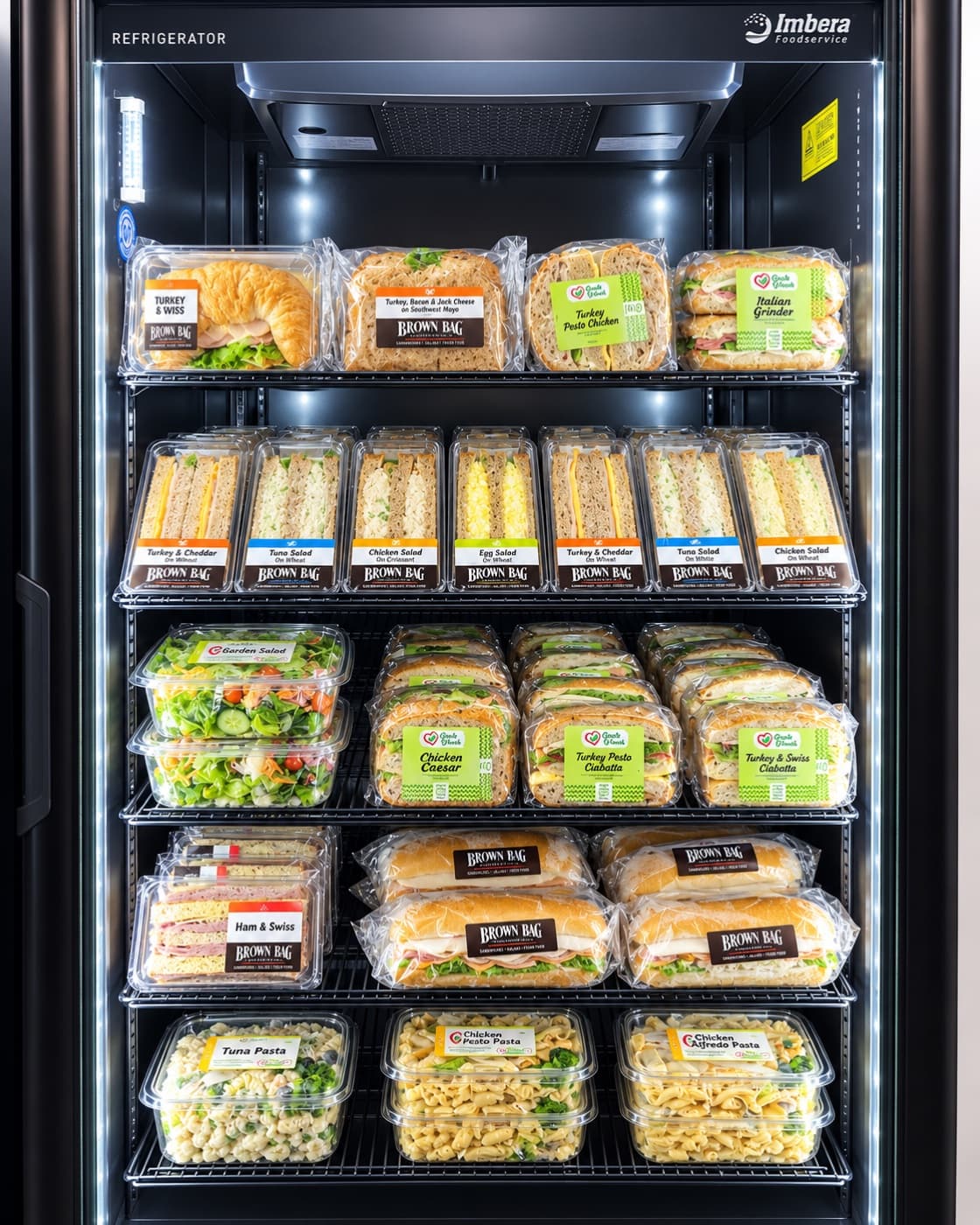
Sandwiches, wraps, salads, pasta bowls and breakfast items from California producers, rotated on date. Plus frozen entrées and ice cream for the back half of a shift.
Equipment
- Imbera refrigerated case
- Smart frozen locker
Self-checkout market
The full open market: a kiosk, open coolers and a dry wall, with no machine fronts between your team and the food. Scan, tap, walk out.
Equipment
- Market kiosk with scanner and card reader
Open on every shift, including the ones nobody caters
Plant and warehouse food service is built around first shift. The band below is a typical LA manufacturing schedule — everything but the market goes dark before second shift is halfway through.
Which one your site can take
The honest answer depends on headcount and how much wall you can give up. We will tell you if a market does not pencil out for your site.
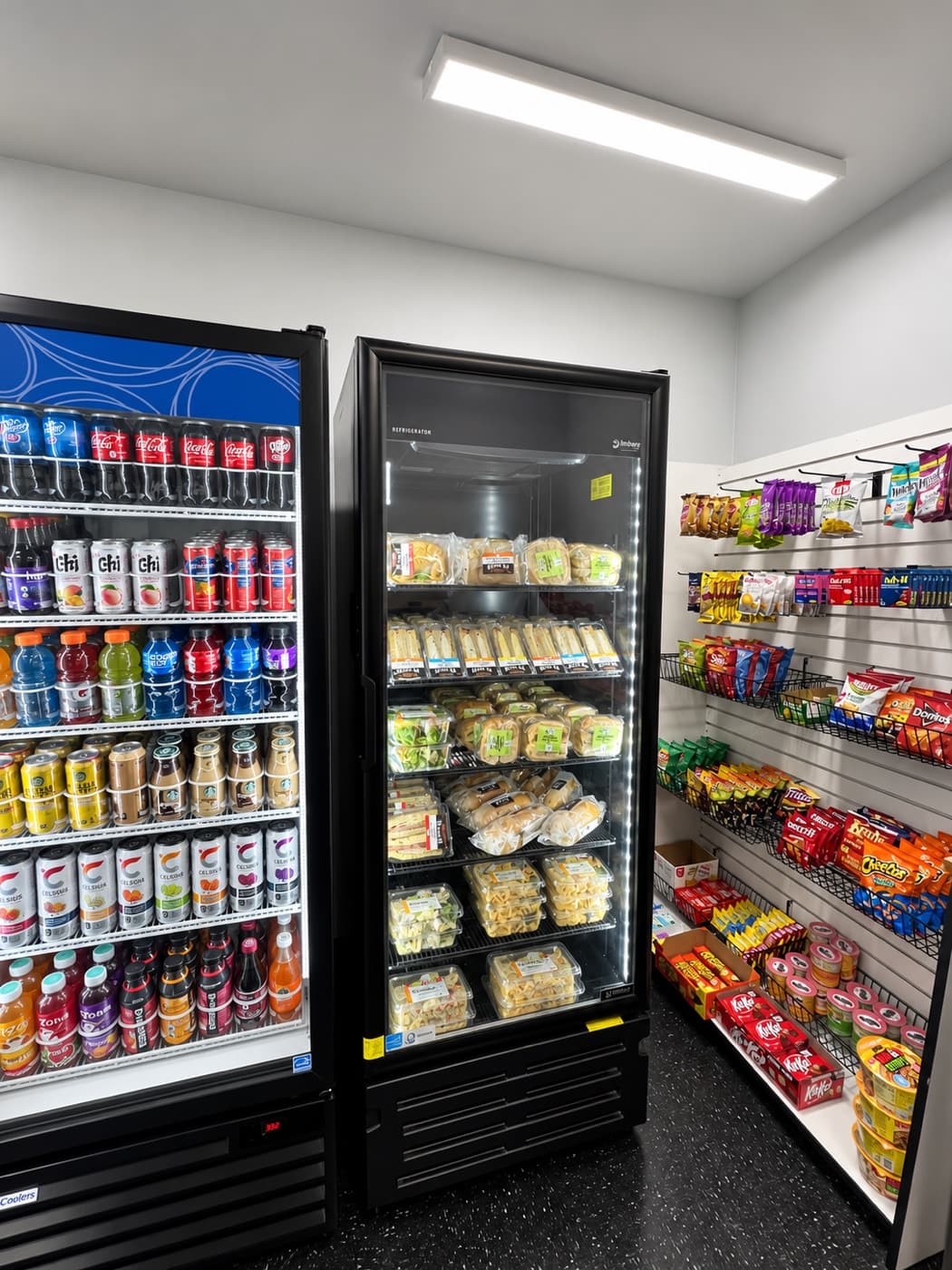
Micro market
An open store in the breakroom. Coolers, freezers, racking, and a self-checkout kiosk.
- Headcount
- 50 and up
- Floor space
- 120 sq ft
- Power
- Two 20-amp circuits
- Selection
- 300–500 items
- Install
- One day
Best for Fresh food, real meals, hot entrees, and a selection you can change by the season.
Vending machines
Tap-to-pay machines where there is no room for a market, or on the far end of a large floor.
- Headcount
- Any
- Floor space
- 8 sq ft per machine
- Power
- One 15-amp circuit
- Selection
- 40–60 items
- Install
- Same week
Best for Satellite breakrooms, guard shacks, mezzanines, and sites under 50 people.
How a site goes live
- Step 1Day 1
Site assessment
We measure the breakroom, find the circuits and count heads per shift. About thirty minutes, no charge, no obligation.
- Step 2Week 1
Planogram and pricing
We build the item mix for your workforce rather than a standard list, and agree shelf prices with you before anything ships.
- Step 3Week 2–3
Install
Equipment comes in outside production hours. The market is stocked and taking payment the same day.
- Step 4Ongoing
Route
A driver on a fixed schedule, plus unscheduled runs whenever telemetry shows an item dropping below par.
You can see what we see
Coolers and machines report what sold and what is left. You get the same view the route driver does, because the fastest way to prove we are keeping shelves full is to let you check for yourself.
| Item | Par | On hand | Status |
|---|---|---|---|
| Chicken burrito | 24 | 19 | In stock |
| Cold brew, 11 oz | 36 | 31 | In stock |
| Turkey sandwich | 18 | 4 | Below par |
| Electrolyte drink | 48 | 44 | In stock |
| Protein bar, mixed | 30 | 26 | In stock |
| Fresh fruit cup | 12 | 0 | Out |
Two items flagged. The next run is already scheduled.
Who we stock in Los Angeles
Breakrooms differ more than people expect. A 400-person distribution center on three shifts needs a different mix and a different restock rhythm than a 60-person design office.
- Warehouses and distribution
- Fulfillment and 3PL sites in Vernon, Commerce, Santa Fe Springs and the Harbor. High volume, heavy on cold drinks and substantial food.
- Manufacturing and aerospace
- Plants and machine shops running round the clock, where the cafeteria closes long before the last shift clocks out.
- Corporate offices
- Headquarters, coworking floors and studio lots across the Valley and the Westside. Heavier on coffee, fresh food and low-sugar lines.
- Healthcare
- Hospitals and clinics where night staff have no other option on site and a vending failure is a real problem.
- Schools and campuses
- Districts and private campuses, with the product mix filtered to whatever the site's nutrition policy allows.
- Government and public service
- Municipal yards, depots and public buildings, including sites that need after-hours access without staff present.
Where we run routes
We serve Los Angeles County and the immediate edges. Proximity is the whole product in this business — a restock promise is only as good as the drive.
- Sylmar
- Pacoima
- Sun Valley
- Chatsworth
- Valencia
- Burbank
- Glendale
- Vernon
- Commerce
- City of Industry
- Santa Fe Springs
- El Monte
- Azusa
- Carson
- Rancho Dominguez
- Compton
- Paramount
- Gardena
- Torrance
- Inglewood
Questions we get asked on site
What does this cost us?
Nothing for the equipment. We own the coolers, the kiosk and the machines, and we install, stock and service them. Your team pays shelf price for what they take. You give up floor space and power.
Do we have to sign a contract?
No. You can run with no agreement at all, or a month-to-month if your procurement team needs paper. Give us reasonable notice and we remove the equipment. There is no termination fee.
What happens when a machine goes down?
You call and a person answers. Most faults are cleared on a same-day or next-day visit by our own technician. Machines with telemetry report their own faults before anyone has to phone them in.
How often do you restock?
A fixed weekly route at minimum, more often at high-traffic sites, plus unscheduled runs whenever an item drops below its par level. Restocking is driven by what sells, not by a standard list.
Can you do healthy options?
Yes, and it is most of what we have added in recent years: low-sugar and zero-sugar drinks, protein and baked snacks, fresh fruit, salads and prepared meals. Tell us the balance you want and we build to it.
How do people pay?
Tap, chip, Apple Pay, Google Pay, Samsung Pay and cash on every machine. Markets add a prepaid account your team loads at the kiosk. Payroll deduction is possible where your HR system supports a file exchange.
How many people do we need on site?
A full market generally wants 50 or more. Below that, machines are usually the better fit, though a smaller site with heavy foot traffic can still work. We will tell you honestly either way.
Where do you run routes?
Los Angeles County — the San Fernando Valley, the Westside, the San Gabriel Valley, the South Bay and the Harbor. If you are just outside it, ask; it depends on the route.
Get a free site assessment
Tell us where the building is and how many people are in it. We come out, measure the breakroom, check the circuits and tell you straight whether a market or machines make more sense.
No commitment. We reply the same business day. No call center.